Is AI Content Bad for SEO? Google's Scaled Content Rules
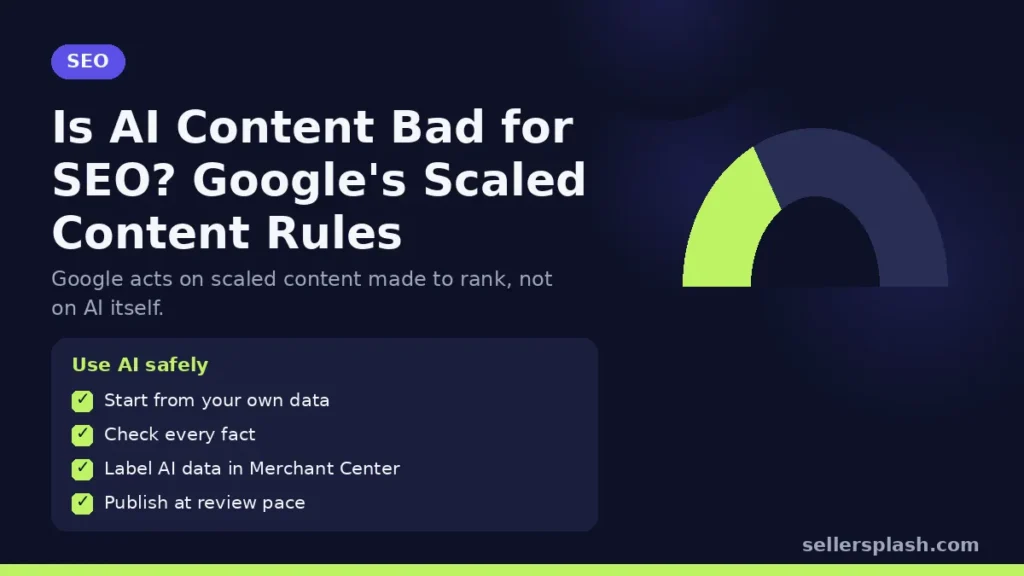
AI content is not bad for SEO by itself. Google has said its focus is on the quality of content, rather than how content is produced. What Google does act on is scaled content abuse: many pages generated for the primary purpose of manipulating search rankings and not helping users, "no matter how it's created." So the real question for a store is not "did a person or a tool write this?" but "would this page be worth publishing if search engines did not exist?" This guide covers what Google's rules actually say, where ecommerce sites get caught, and how to use AI without putting your traffic at risk.
What Google Says About AI Generated Content
Three Google documents set the rules:
- The 2023 guidance on AI content. Google's Search Central post says its ranking systems aim to reward original, high quality content that demonstrates experience, expertise, authoritativeness and trustworthiness, which Google calls E-E-A-T, regardless of how the content was made.
- The generative AI content guide. Google's guide for site owners says generative AI can be useful for research and for adding structure to original content, but that using it to generate many pages without adding value for users may violate the scaled content abuse policy. It also reminds publishers that generative models predict a likely sequence of words rather than retrieving facts, so accuracy has to be checked.
- The spam policies. The spam policies list examples of scaled content abuse, including using generative AI tools to generate many pages without adding value, scraping feeds or search results to create content, and stitching content from different pages together without adding value. Google says sites that violate its policies may rank lower or not appear in results at all, and that it detects violations both automatically and, as needed, through human review that can lead to a manual action.
Where Ecommerce Sites Get Caught
Stores rarely set out to spam. They usually slide into it through volume. These are the patterns that most often match Google's examples:
| Pattern | Why it is risky | Safer version |
|---|---|---|
| Hundreds of "best X in [city]" pages from one template | Substantially similar pages built to catch searches, a pattern the spam policies describe | A few pages for places you actually serve, each with real local detail |
| Daily AI blog posts with no editing | Many pages with little added value and possible factual errors | Fewer posts, each fact checked and grounded in your own products or data |
| Whole catalog descriptions rewritten by a tool | Unoriginal text that can be less accurate than the manufacturer's specs | AI drafts reviewed against specs, with your own fit, sizing and use notes |
| Comparison pages for products you have never handled | Content that claims experience it does not have | Comparisons built on published specs, clearly sourced |
Extra Rules for AI Product Data in Merchant Center
If you send products to Google Shopping, the rules are stricter than for your blog. Google's generative AI guide points ecommerce sites to Merchant Center's policies for AI generated content:
- AI generated product images must carry IPTC DigitalSourceType TrainedAlgorithmicMedia metadata. Google's image metadata documentation explains how that metadata is added.
- AI generated titles must be sent in the structured_title attribute, and AI generated descriptions in the structured_description attribute, each with digital_source_type set to trained_algorithmic_media.
In other words, Merchant Center does not ban AI product text. It asks you to label it in the feed.
How to Use AI for SEO Without Risk: 6 Rules
1. Start from information only you have
Product specs, return data, customer questions, sizing feedback and your own photos are the raw material AI cannot invent. Content built on them is original by definition.
2. Use AI for structure and drafts, not final copy
Google's guide names research and structure as useful uses. Let AI outline a buying guide or summarize your customer FAQ, then have someone who knows the products rewrite and check it.
3. Check every fact and number
Because generative models predict text rather than look up facts, every spec, price, date and claim needs a check against a primary source before it goes live.
4. Make the author clear
Google's helpful content guidance suggests asking "Who, How, and Why" about each page, starting with whether it is self evident to visitors who created the content. A byline and an about page that explains who runs the store help readers and search systems alike.
5. Publish at the pace you can review
The scaled content policy is about many pages with little value. Ten useful guides beat two hundred thin ones, and they are also cheaper to keep accurate.
6. Prune what does not help
If you already published a large batch of weak AI pages, improving or removing them is better than waiting. Google's guidance is the same either way: the content should help the people who land on it.
Quick Checklist
- Every page answers a real shopper question
- Facts and numbers checked against primary sources
- Own data, photos or experience added to each page
- Clear author and about page
- AI product images and text labeled in Merchant Center
- Publishing pace matched to review capacity
Where an Agency Fits
Most of our AI search optimization clients ask the same thing: can we use AI and still rank? Yes, with an editor in the loop and facts that are checked. Our post on automated SEO for ecommerce covers which technical tasks are safe to automate, and our answer engine optimization guide covers how to write pages AI assistants cite.
Worried some of your pages look thin? The Full AI Visibility Audit ($99) reviews your site's AI readiness and crawler access, and the Deep Growth Audit ($249) adds search, traffic and content checks with a 90 day plan.
Frequently Asked Questions
Does Google penalize AI generated content?
Not for being AI generated. Google says its focus is on the quality of content rather than how it is produced. Using AI to generate many pages without adding value for users may violate its scaled content abuse policy.
What is scaled content abuse?
Google defines it as many pages generated for the primary purpose of manipulating search rankings and not helping users, typically large amounts of unoriginal content with little or no value, no matter how it is created.
Can I use AI to write product descriptions?
Yes, if they are accurate and reviewed. For Google Shopping, Merchant Center requires AI generated descriptions to be sent in the structured_description attribute and labeled with digital_source_type trained_algorithmic_media.
Do I need to label AI generated product images?
For Merchant Center, yes. Google says AI generated images must contain IPTC DigitalSourceType TrainedAlgorithmicMedia metadata.
What happens if Google thinks my site has scaled content?
Google says sites that violate its spam policies may rank lower or not appear in results at all, and that human review can result in a manual action, which shows in Search Console.
How many blog posts should an online store publish?
Google sets no number. Publish only as many as you can research, fact check and keep accurate, and make each one answer a real customer question.
AI search and ads readiness checklist
25 checks for Amazon, Walmart and Shopify sellers: tracking, product feeds, Google, Bing and Meta ads, and getting cited by ChatGPT, Perplexity and Google AI Overviews. Two pages, about 20 minutes.
- Break-even ROAS table by margin
- The AI search (AEO) checks most stores miss
- A simple score that tells you what to fix first
No spam. We use your email to send the checklist and follow up about it.
Want to see where your store stands in AI search? Get the Full AI Visibility Audit for $99 or the Deep Growth Audit for $249.
Get your AI visibility audit