Are Reciprocal Backlink Networks Safe? Google's Spam Policies
Disclosure: this post contains affiliate links. We may earn a commission at no extra cost to you. Read our affiliate disclosure
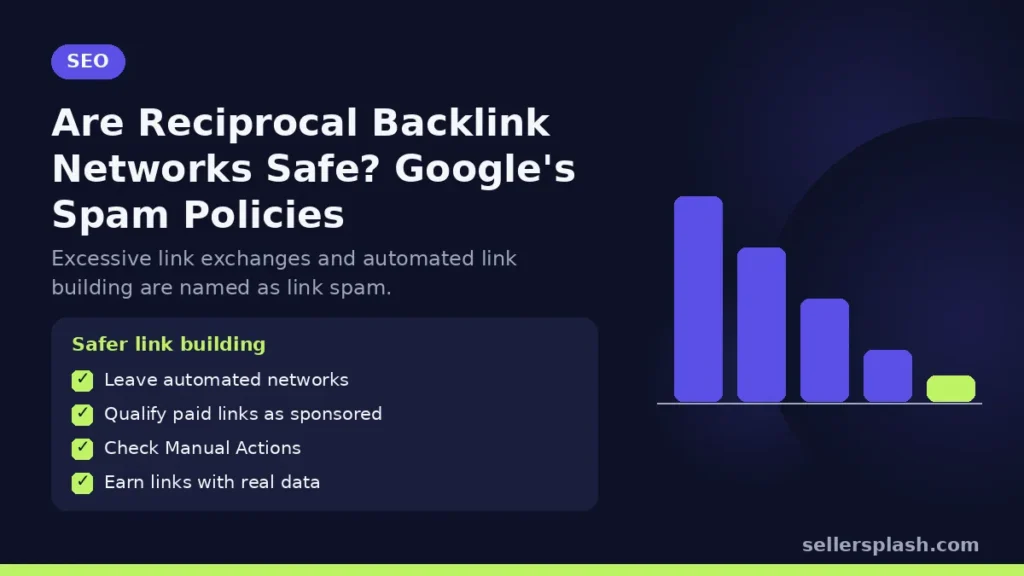
No, reciprocal backlink networks are not safe for SEO. Google's spam policies list "excessive link exchanges ('Link to me and I'll link to you') or partner pages exclusively for the sake of cross-linking" as link spam, and they separately list "using automated programs or services to create links to your site." A network that swaps links between member sites automatically matches both descriptions. The best case is that the links are ignored. The worst case is a manual action against your site. Normal, occasional links between businesses that genuinely work together are a different thing, and this guide explains where the line sits.
What Google Calls Link Spam
Google defines link spam as "the practice of creating links to or from a site primarily for the purpose of manipulating search rankings." Its list of examples includes:
- Buying or selling links for ranking purposes, including exchanging money, goods or services for links, or sending someone a product in exchange for a review that includes a link
- Excessive link exchanges or partner pages built only for cross linking
- Using automated programs or services to create links to your site
- Requiring a link in terms of service or a contract without letting the other site qualify it
- Advertorials, guest posts or press releases with links that pass ranking credit or use optimized anchor text
Notice the word "primarily." Google does not object to links between related businesses. It objects to links whose main job is to move rankings.
How Reciprocal Link Networks Work
Most networks follow the same pattern. A site joins, installs a plugin or allows an automated publisher, and in return for receiving links from other members it publishes posts or pages that link out to them. Some tools publish articles on member sites on a schedule, with anchor text chosen to target keywords. Members often have nothing in common except the network.
Each of those features lines up with a named example in Google's policy: the exchange is the price of entry, the links are created by an automated service, and the anchor text is optimized. There is no ambiguity to argue about.
What Google Does About It
Google described its approach in the December 2022 link spam update: its AI based system, SpamBrain, can detect both sites buying links and sites used to pass outgoing links, and Google uses it to neutralize the impact of unnatural links. When links are neutralized, any ranking boost they were giving goes away, so rankings built on them can drop even without a penalty.
The spam policies also say violations are detected by automated systems and, as needed, human review that can lead to a manual action. A manual action is reported in the Manual Actions report in Search Console. Google's instructions are to fix the issue on all affected pages, then select Request Review and describe the fixes; fixing only some pages does not earn a partial return to search results.
There is a second risk that gets less attention: the pages a network publishes on your site link out to unrelated businesses. Those outgoing links are also covered by the policy, and the posts are usually thin, which brings in the scaled content questions we covered separately.
What Is Normal and What Is Not
| Situation | Usually fine | Risky |
|---|---|---|
| Linking to a supplier or partner | A real partner page that helps customers find them | A "partners" page listing dozens of unrelated sites that link back |
| Guest articles | Useful article, links qualified with rel="sponsored" or rel="nofollow" where any payment or exchange is involved | Articles written to place keyword anchor links |
| Product reviews | Sending a product to a reviewer who marks the link as sponsored | Free product in exchange for a followed link |
| Link tools and plugins | Tools that help you find broken links or unlinked mentions | Tools that create links on other sites automatically |
Google's guide to qualifying outbound links explains the rel values: rel="sponsored" for advertisements or paid placements, rel="ugc" for user generated content, and rel="nofollow" for other links you do not want to vouch for. Google says nofollow is still acceptable for paid links, but sponsored is preferred.
If You Already Joined a Network: 5 Steps
- Stop new placements. Turn off the plugin or automated publisher so no more posts or links go out.
- List what it published on your site. Find every post or page the network created and every outgoing link it added.
- Remove or qualify those links. Delete posts with no value to your visitors. Where a post is genuinely useful, keep it and add rel="nofollow" or rel="sponsored" to the exchanged links.
- Check Search Console for manual actions. If there is one, clean up first, then file a reconsideration request that explains what you removed.
- Use the disavow tool only if you need to. Google says most sites will not need to use the disavow tool, and that it is meant for sites with a considerable number of spammy or artificial links that have caused, or likely will cause, a manual action.
Safer Ways for a Store to Earn Links
- Publish original data from your own business, such as sizing research or return reasons, that others want to cite
- Write the best buying guide in your niche, with clear sources
- Ask suppliers, manufacturers and stockists to list you where they already list retailers
- Reach out when a site mentions your brand without linking
- Make links crawlable: Google's link best practices ask for real anchor elements with an href and descriptive anchor text
Quick Checklist
- No membership in automated link exchange networks
- No partner pages that exist only for cross linking
- Paid or exchanged links marked sponsored or nofollow
- No keyword anchor links in guest posts or press releases
- Search Console checked for manual actions
Where an Agency Fits
Links still matter, but the ones that last are earned. Our AI search optimization service focuses on content and data that other sites and AI assistants want to cite, with no link exchanges. If you are comparing SEO services, our page on choosing an SEO service for an online store covers the backlink question in more detail.
Not sure what your link profile looks like? The Full AI Visibility Audit ($99) covers AI readiness and crawler access, and the Deep Growth Audit ($249) adds search, traffic and site checks with a 90 day plan.
Frequently Asked Questions
Are reciprocal links bad for SEO?
Occasional links between related businesses are normal. Google's spam policies name excessive link exchanges and partner pages made only for cross linking as link spam, so systematic swapping for rankings is the problem.
Are automated backlink networks against Google's rules?
Yes. Google's spam policies list using automated programs or services to create links to your site as an example of link spam.
What does Google do with spammy links?
Google says its SpamBrain system can detect sites buying links and sites used to pass outgoing links, and it neutralizes unnatural links. Violations can also lead to a manual action after human review.
Should I disavow links from a link network?
Usually only if you have a considerable number of spammy links that caused, or likely will cause, a manual action. Google says most sites will not need the disavow tool. Removing the links you control comes first.
Which rel attribute should I use for exchanged or paid links?
Google recommends rel="sponsored" for paid placements and says rel="nofollow" is still acceptable. Use rel="ugc" for links in user generated content such as comments.
How can an online store build links safely?
Earn them with content and data others want to cite, ask suppliers and stockists to list you, and follow up on unlinked brand mentions, without paying or exchanging for followed links.
AI search and ads readiness checklist
25 checks for Amazon, Walmart and Shopify sellers: tracking, product feeds, Google, Bing and Meta ads, and getting cited by ChatGPT, Perplexity and Google AI Overviews. Two pages, about 20 minutes.
- Break-even ROAS table by margin
- The AI search (AEO) checks most stores miss
- A simple score that tells you what to fix first
No spam. We use your email to send the checklist and follow up about it.
Want to see where your store stands in AI search? Get the Full AI Visibility Audit for $99 or the Deep Growth Audit for $249.
Get your AI visibility audit