Does FAQ Schema Still Help SEO?
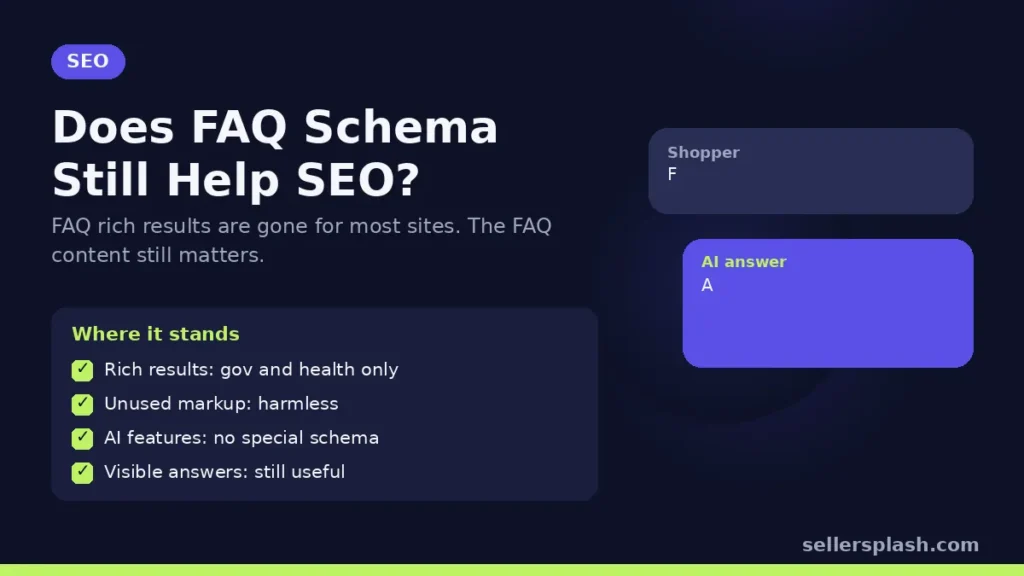
FAQ schema no longer earns FAQ rich results for most websites. In August 2023 Google announced that FAQ rich results would only be shown for well-known, authoritative government and health websites, and that for all other sites they would no longer be shown regularly. Google also said there is no need to remove the markup: structured data that is not used causes no problems for Search, but has no visible effect either. For an online store, a visible FAQ section is still worth having for shoppers and for AI answers, and the FAQPage markup is optional. This guide explains what changed and what to do instead.
What Google Changed in 2023
Google's Search Central announcement made two changes:
- FAQ rich results: limited to well-known, authoritative government and health websites. Sites may be considered automatically based on eligibility.
- How-To rich results: first limited to desktop, and later removed. Google's documentation changelog notes the How-to documentation was removed because the rich result is no longer shown on desktop or mobile.
Google's FAQPage documentation still exists and states the same eligibility limit.
Does FAQ Schema Help Rankings or AI Answers?
Google has not said that FAQPage markup is a ranking factor. For AI features, Google's guidance on AI features and your website is direct: you don't need to create new machine readable files, AI text files or markup to appear in AI Overviews or AI Mode, and there is no special schema.org structured data you need to add. The same guidance recommends making important content available in text form and making sure your structured data matches the visible text on the page.
What does help is the content itself. Clear questions with short, direct answers are easy for people to scan and easy for search engines and AI systems to understand and quote. The markup is a label on that content, not a substitute for it.
Keep It, Add It or Remove It?
| Situation | Recommendation |
|---|---|
| FAQ markup already on pages, matching visible content | Keep it. Google says unused structured data causes no problems. |
| FAQ markup describing questions not shown on the page | Fix or remove it. Google's guidelines say not to mark up content that is not visible to readers. |
| New guide or category page with real customer questions | Add a visible FAQ section; markup is optional. |
| Product pages | Prioritize Product and merchant listing markup, which still powers shopping results. |
The visibility rule comes from Google's general structured data guidelines: don't mark up content that is not visible to readers, and don't mark up irrelevant or misleading content.
How to Write FAQs Worth Keeping: 5 Steps
1. Use real questions
Pull them from customer service emails, chat logs, reviews and Search Console queries that start with how, what, can or does.
2. Answer in the first sentence
Lead with the answer, then add one or two sentences of detail. A shopper on a phone should get the point in one glance.
3. Keep answers factual and current
Shipping times, return windows and sizing details change. An outdated FAQ answer costs trust and creates support tickets.
4. Match markup to the visible text
If you use FAQPage markup, the questions and answers in the JSON should match what is on the page, word for word where possible.
5. Don't repeat the same FAQ everywhere
Identical FAQ blocks across hundreds of product pages add little. Put store wide questions on one help page and keep product FAQs specific.
Where FAQs Belong on a Store
- Category pages: a few questions under the product grid about sizing, materials or choosing between types help shoppers decide and add useful text to thin category pages.
- Product pages: questions specific to that product, such as compatibility, care instructions or what is in the box. Keep them short so they do not push reviews and the add to cart button down.
- Help or policy pages: shipping, returns, payment and order tracking. One well maintained page beats the same answers repeated on every product.
- Buying guides and blog posts: follow up questions that the article raises, like the FAQ at the end of this guide.
Wherever you place them, review FAQs whenever a policy, price or product spec changes. Google's structured data guidelines ask for up to date information, and shoppers expect the same.
Quick Checklist
- FAQ sections answer real customer questions
- First sentence of each answer is the answer
- Any FAQPage markup matches visible content
- No expectation of FAQ rich results unless you are a government or health site
- Product structured data prioritized on product pages
Where an Agency Fits
Structured data is a small part of being understood by search and AI. Our answer engine optimization guide covers the content side, and our AI search optimization service handles it for stores that want help.
Want to know how AI assistants see your store? The Full AI Visibility Audit ($99) includes a site scan of AI crawler access and structured data, and the Deep Growth Audit ($249) adds search, traffic and product feed checks with a 90 day plan.
Frequently Asked Questions
Does Google still show FAQ rich results?
Only for well-known, authoritative government and health websites, according to Google's August 2023 announcement. Other sites no longer get them regularly.
Should I remove FAQ schema from my site?
There is no need. Google says unused structured data does not cause problems for Search, though it has no visible effect. Remove or fix markup that describes content not visible on the page.
Does FAQ schema help with AI Overviews?
Google says there is no special schema.org structured data you need to add to appear in AI features. Clear visible content matters more.
Is FAQ schema a ranking factor?
Google has not said that it is. Its value today is mainly as a label for visible question and answer content.
What happened to How-To rich results?
Google first limited them to desktop in 2023 and later removed them, along with the How-to structured data documentation.
Are FAQ sections still worth adding to store pages?
Yes, when they answer real customer questions clearly. They help shoppers and give search engines and AI systems direct answers to quote.
AI search and ads readiness checklist
25 checks for Amazon, Walmart and Shopify sellers: tracking, product feeds, Google, Bing and Meta ads, and getting cited by ChatGPT, Perplexity and Google AI Overviews. Two pages, about 20 minutes.
- Break-even ROAS table by margin
- The AI search (AEO) checks most stores miss
- A simple score that tells you what to fix first
No spam. We use your email to send the checklist and follow up about it.
Want to see where your store stands in AI search? Get the Full AI Visibility Audit for $99 or the Deep Growth Audit for $249.
Get your AI visibility audit