Meta Andromeda Update: What Advertisers Should Do Now
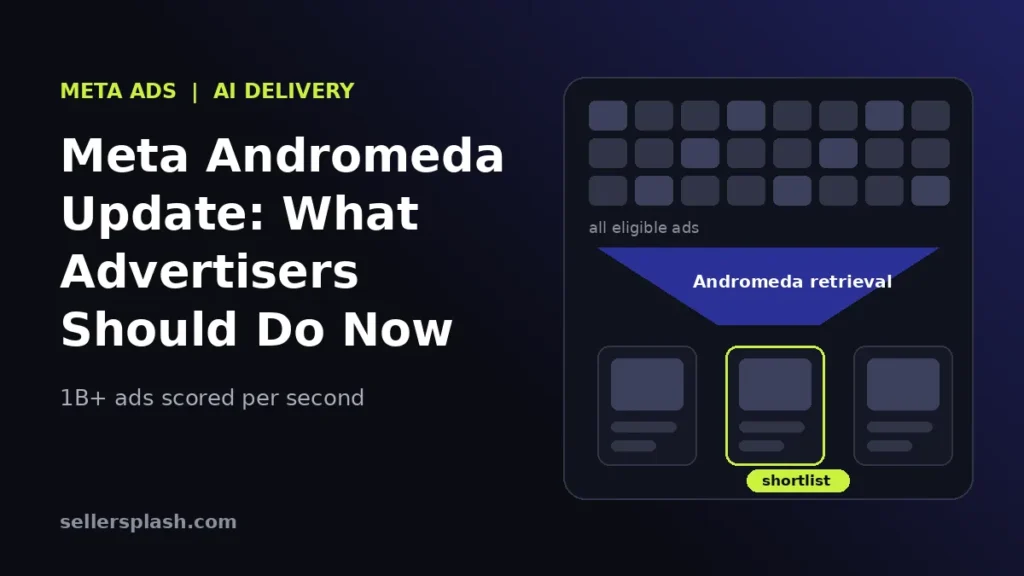
The Meta Andromeda update is an upgrade to the AI system that decides which ads are even considered for each person on Facebook and Instagram, and you do not need to change a setting to get it. On October 28, 2026, Meta's engineering team published the details: the new retrieval system scores every eligible ad with near ranking level accuracy and surfaces the top candidates at over one billion ads per second, which Meta calls a 100x lift over the 2024 Andromeda system. Meta also says Andromeda has delivered a 2.4% increase in conversions on Facebook since 2025.
For advertisers, the practical question is what to do with it. Meta's own write up says the system now matches ads "across a larger candidate pool" and that the pool keeps growing because of Advantage+ automation and generative AI creative tools. That points to a clear playbook: feed the system more distinct creative, give it room to find buyers, and send it clean conversion data. Below is what changed and the steps we would take in an account this week.
Quick Answer
- What Andromeda does: it is the first stage of Meta ad delivery, narrowing a vast pool of eligible ads down to a small set of candidates for each person, per Engineering at Meta.
- What is new: a new retrieval model architecture that runs the full retrieval pipeline on one GPU server, with over one billion ads per second scored within the same latency budget.
- Reported impact: a 2.4% increase in conversions on Facebook since 2025, according to Meta.
- Settings to change: none. The upgrade is automatic.
- What you control: creative variety, audience settings and conversion signal quality.
What Meta Andromeda Is and Why It Matters
Every time someone opens Facebook or Instagram, Meta has to pick a few ads out of a huge number of eligible ones. That happens in stages. Meta describes Andromeda as its machine learning system for personalized ads retrieval, the first stage of the ads recommendation pipeline. Retrieval narrows the pool to strong candidates, and later ranking stages pick the winner.
Retrieval sounds like plumbing, but it decides whether your ad gets a chance at all. Meta says it plainly in the post: small improvements in retrieval model performance can drive large gains in advertiser value. If your ad never makes the shortlist for a person, no bid or budget will show it to them.
Andromeda first launched in December 2024. Meta says that since then, generative AI creative tools have helped advertisers create hundreds of millions of new ads, so the candidate pool grew to a scale the old setup had to work harder to score. The October 2026 update is Meta's answer to that growth.
What Changed in the October 2026 Update
According to the October 28 engineering post, three things changed:
| Change | What Meta says | What it means for you |
|---|---|---|
| Smarter retrieval model | A new mixture of experts design gives near ranking level expressiveness at no additional serving cost | Better first pass matching between your ad and the right person |
| Whole pipeline on one GPU server | Targeting rule matching moved onto the GPU, cutting network traffic by about 100x | Your targeting rules are still enforced, just faster |
| More ads scored per second | Over one billion ads per second, a 100x lift over the 2024 system | More of your ads can be evaluated for each person |
Source: Engineering at Meta, Meta Andromeda: Powering the Next Generation of Ads Retrieval, October 28, 2026.
This sits next to another October update. On October 13, 2026, Meta described the 2026 generation of GEM, its Generative Ads Model, and said GEM has delivered an 18.9% conversion improvement and a 12% click through rate improvement across its ad surfaces and objectives. Andromeda chooses which ads are considered. GEM helps predict which ones people will click and buy from. Both reward the same inputs.
6 Steps for Meta Advertisers After the Andromeda Update
None of these require a new tool. They are about giving the system what it is built to use, based on Meta's own published guidance.
- Build truly different creative concepts, not small variations. Meta's creative diversification guidance says to develop ads that differ in look, feel, storyline and message, instead of tweaking one ad. Aim for several concepts per ad set: a product demo, a customer problem, a price or offer angle and a founder or brand story, for example.
- Write each concept for a different buyer motivation. Meta suggests segmenting messages, such as one ad built on emotional appeal and another on product features. A bigger candidate pool only helps if the candidates actually say different things.
- Test Advantage+ audience on prospecting. Meta's Business Help Center recommends A/B testing Advantage+ audience for almost all campaign types and says it is not recommended for retargeting. Meta reports 7.2% lower cost per result for Sales and App promotion objectives with Advantage+ audience. Run your own A/B test on one prospecting campaign before you move budget.
- Fix your conversion signal before you scale. Retrieval and ranking learn from outcomes. Meta says the Conversions API creates a more reliable connection between your server, website platform or CRM and Meta's ad optimization systems. Check that Pixel and Conversions API events are both firing, deduplicated and passing purchase values.
- Make every format usable. Meta's creative best practices recommend vertical or square video, short text, carousels for product ranges, movement and clear call to action buttons. Ads that work across placements give the system more places to show them.
- Judge creative on a longer window and refresh what fatigues. Meta's guidance says rotating distinct creatives helps avoid drops in engagement and higher costs. Read results per concept over a few weeks, keep winners running, and replace concepts that decline instead of pausing the whole ad set.
What This Means for Ecommerce Brands
Going into the holiday season, the brands that benefit most from a smarter retrieval system are the ones with a deep, varied creative library and accurate purchase data. Meta reports that advertisers who turned on the AI driven targeting features of Advantage+ sales campaigns for the first time saw, on average, a 22% increase in ROAS and $4.52 return for every dollar spent (Meta for Business). That is Meta's own data, so treat it as a reason to test, not a promise for your account.
The other takeaway is about profit, not platform features. More automation means you set fewer manual levers, so your ROAS target has to be right. Our guide to break even ROAS for Meta ads shows how to set one, and our Black Friday ecommerce advertising guide covers holiday timing. If you want a team to rebuild your creative testing and Advantage+ setup, see our Meta ads agency service.
Want an expert review of your store before you spend more on Meta? Get the Full AI Visibility Audit ($99) or the Deep Growth Audit ($249) for a deeper review.
Frequently Asked Questions
What is Meta Andromeda?
Andromeda is Meta's machine learning system for personalized ads retrieval. It is the first stage of ad delivery: it narrows the huge pool of eligible ads down to a small set of strong candidates for each person, and later ranking stages decide which ad actually shows.
What changed in the October 2026 Andromeda update?
On October 28, 2026, Meta's engineering team described a new retrieval architecture that scores every eligible ad with near ranking level accuracy and runs the whole retrieval pipeline on a single GPU server. Meta says it surfaces top candidates at over one billion ads per second, about 100 times the 2024 system, within the same latency budget.
Do I need to change any settings for the Andromeda update?
No. There is no setting to turn on. Meta says advertisers get better performance automatically because retrieval now matches ads across a larger candidate pool. What you control is the input: your creative mix, your targeting settings and the quality of your conversion data.
How is Andromeda different from GEM?
Andromeda handles retrieval, choosing which ads are considered. GEM, Meta's Generative Ads Model, is a central foundation model that helps predict clicks and conversions across Facebook, Instagram and other surfaces. Meta explains each one in its own engineering post.
Should I still use detailed interest targeting on Meta?
Meta recommends testing Advantage+ audience for almost all campaign types, and says retargeting campaigns are the exception. A practical approach is to A/B test Advantage+ audience against your current setup on one prospecting campaign before switching everything.
Does more creative variety really matter now?
Meta's own guidance says to build ads that are truly different in look, story and message rather than small tweaks of one ad, because the system is designed to find the right audience for each distinct message. Retrieval that scores a larger pool of ads makes that variety more useful, not less.
AI search and ads readiness checklist
25 checks for Amazon, Walmart and Shopify sellers: tracking, product feeds, Google, Bing and Meta ads, and getting cited by ChatGPT, Perplexity and Google AI Overviews. Two pages, about 20 minutes.
- Break-even ROAS table by margin
- The AI search (AEO) checks most stores miss
- A simple score that tells you what to fix first
No spam. We use your email to send the checklist and follow up about it.
Want to see where your store stands in AI search? Get the Full AI Visibility Audit for $99 or the Deep Growth Audit for $249.
Get your AI visibility audit