Google AI Mode Ads: What Advertisers Need to Know
Ads in Google AI Mode are standard Google Ads that appear inside AI Mode's conversational answers, labeled "Sponsored," and you do not need a new campaign to show up there. On October 28, 2026, Google said it is scaling ads in AI Mode to Australia, Canada, India, Kenya, Malaysia, New Zealand, Nigeria, Pakistan, the Philippines and Singapore, and launching multiturn ads in the US so ads can appear in follow-up questions too.
For an ecommerce store this matters because AI Mode searches look different. Google says AI Mode queries are on average three times longer than traditional searches (Google AI Mode Report, US, May 2026, cited in the announcement). Longer questions reward a different setup than a tight list of exact match keywords. Below is how these ads work, which campaigns qualify and the steps we would take to get an account ready.
Quick Answer
- Who is eligible: existing Search, Shopping and Performance Max campaigns, automatically, per Google Ads Help.
- Formats: text ads and Shopping ads. Google says it is also experimenting with local inventory ads and vehicle ads.
- What is new: 10 more countries now, Brazil, Mexico and the United Kingdom planned for Q4 2026, and multiturn ads in the US, per the Google Ads blog.
- Controls: you cannot opt out of AI Mode or target it alone. Negative keywords, brand exclusions and asset pinning still apply.
- Cost: same auction and same bidding as regular Search ads, with no extra fee.
How Google AI Mode Ads Match to Searches
Google describes two ways an ad can match in AI Overviews and AI Mode:
- Direct query matching: the search already shows buying intent, such as "pool vacuum cleaners," and the ad matches the query the same way it would on a normal results page.
- Contextual matching: the search is exploratory, such as "why is my pool green and how do I clean it?" Google matches ads to both the question and the AI answer, so an answer about brushing and vacuuming can surface ads for pool vacuums or algae kits.
That second path is the opportunity. A shopper who never typed a product name can still see your product, but only if your campaign uses targeting that is eligible for contextual matching.
| Targeting | Direct query matching | Contextual matching |
|---|---|---|
| AI Max for Search campaigns | Yes | Yes |
| Broad match (Search) | Yes | Yes |
| Shopping campaigns | Yes | Yes |
| Performance Max | Yes | Yes |
| Exact and phrase match (Search) | Yes, when the query shows direct buying intent | No |
Source: Google Ads Help, About ads in AI-powered experiences in Google Search.
What Multiturn Ads Mean
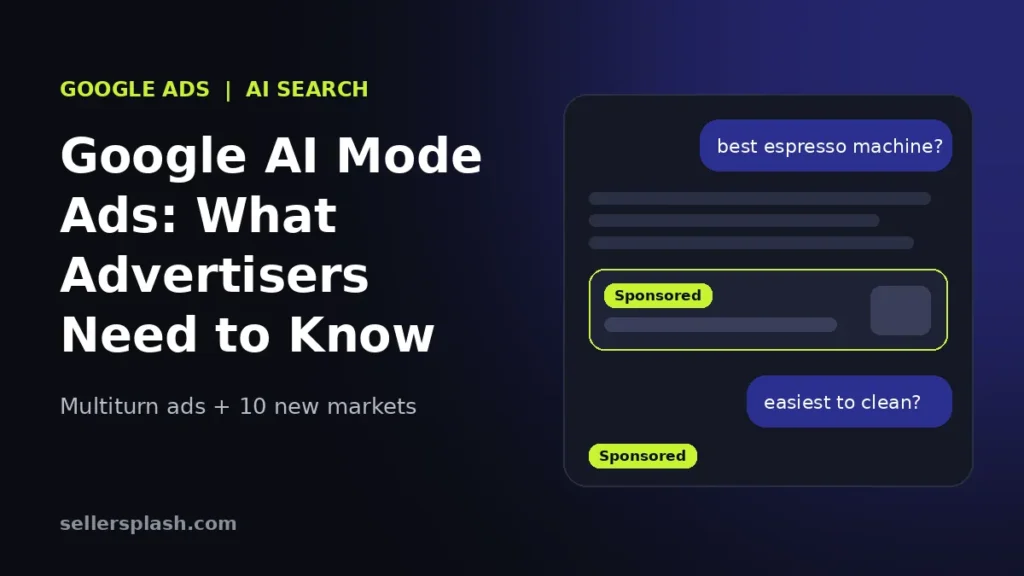
AI Mode is a conversation. Someone asks a question, reads the answer, then asks a follow-up. Google says it is launching multiturn ads in the US so ads can show in those follow-up queries, not only the first one. The support page confirms ads can appear "across follow-up questions in AI Mode" when the conversation has commercial relevance.
In practice, the shopper who starts with "best espresso machine for a small kitchen" and follows up with "which one is easiest to clean" can see ads at the second step, where intent is often sharper. Your assets, prices and landing pages need to answer those narrower follow-ups.
AI Explainers: Text You Do Not Write
Some placements show your ad with an AI explainer, a short piece of text generated by Google's Gemini models that explains how the ad relates to the search. According to Google, explainers can draw on the query, the AI answer and public sources including your website. Advertisers cannot write, edit, approve or opt out of them.
The only lever you have is your own site. Google says keeping your website content clear and up to date helps it surface accurate context in explainers. Outdated specs, vague product pages or conflicting shipping info can end up described next to your ad.
6 Steps to Prepare Your Campaigns for AI Mode Ads
These steps follow Google's own best practices for ads in AI Overviews and AI Mode.
- Add targeting that qualifies for contextual matching. If your account runs mostly exact and phrase match, test AI Max for Search with search term matching on, or broad match, on your best campaigns. Keep exact match for core terms you want to control.
- Pair it with Smart Bidding and clean conversion data. Google recommends conversion or value based Smart Bidding backed by accurate first party measurement through the Google tag or offline conversion imports. Broad targeting without good conversion data tends to waste spend.
- Keep budgets flexible on winners. Google advises leaving room on high performing campaigns so bidding can reach both direct searches and exploratory questions.
- Turn on text customization and final URL expansion. In AI Max and Performance Max these let headlines, descriptions and landing pages adapt to longer, conversational queries. Review the landing pages Google picks and exclude any that convert poorly.
- Fix your Merchant Center feed. For Shopping ads, Google lists descriptive titles and descriptions, multiple high resolution product and lifestyle images, accurate prices and sale prices, product ratings and highlights, and clear shipping and return policies. Make sure the feed matches your landing pages.
- Tighten negatives and brand exclusions. Broader matching brings in more question style queries. Check the search terms report weekly, since Google says AI Mode queries are included there in aggregate, and add negatives for anything irrelevant.
What This Means for Ecommerce Brands
Google reports that click-through rates are already similar between sponsored and organic product list items within AI Mode (Google internal data, US, August 20 to September 3, 2026, per the announcement). That is Google's own data, so treat it as a signal to test, not a promise for your account.
The bigger shift is that paid and organic AI visibility are now separate games played on the same screen. Google says buying ads does not influence organic AI answers. To be both cited and advertised, you need AI search work on your site and a Google Ads setup built for conversational queries. Our breakdown of the AI Overviews links update covers the organic side, and our guide to answer engine optimization shows how to structure pages AI features cite. If you want a team to set up AI Max, feeds and bidding for AI Mode, see our Google Ads management service.
Want to see where your store stands in AI search before you spend? Get the Full AI Visibility Audit ($99) or the Deep Growth Audit ($249) for a deeper review.
Frequently Asked Questions
Do I need a new campaign to run ads in Google AI Mode?
No. Google says existing Search, Shopping and Performance Max campaigns are automatically eligible for ads in AI Overviews and AI Mode through the normal auction. There is no separate campaign type or budget to set up.
Can I opt out of ads in AI Mode or target only AI Mode?
No. Google says you cannot target ads only to AI Overviews or AI Mode, and you cannot opt out of them separately from Search. Negative keywords and brand exclusions still control when your ads serve.
Do exact match keywords show ads in AI Mode?
Only sometimes. Google says exact and phrase match keywords can serve when the query itself shows direct buying intent, but they are not eligible for contextual matching on longer, exploratory questions. AI Max, broad match, Shopping and Performance Max are eligible for both.
How are ads in AI Mode billed?
Google says they use the same auction and the same cost per click or conversion based bidding as standard Search ads. There is no extra charge to take part, and standard invalid traffic protections apply.
Can I see AI Mode ad performance separately in Google Ads?
Not on its own. Google says AI Overviews and AI Mode results are included in aggregate in your standard campaign reports and in the search terms report, so they are mixed in with your other Search traffic.
Do ads change what Google's AI says about my brand organically?
No. Google says organic AI Overviews and AI Mode answers are generated independently, buying ads does not influence them, and being cited organically does not affect your ad eligibility.
AI search and ads readiness checklist
25 checks for Amazon, Walmart and Shopify sellers: tracking, product feeds, Google, Bing and Meta ads, and getting cited by ChatGPT, Perplexity and Google AI Overviews. Two pages, about 20 minutes.
- Break-even ROAS table by margin
- The AI search (AEO) checks most stores miss
- A simple score that tells you what to fix first
No spam. We use your email to send the checklist and follow up about it.
Want to see where your store stands in AI search? Get the Full AI Visibility Audit for $99 or the Deep Growth Audit for $249.
Get your AI visibility audit