Meta Ad Terms Update: What Advertisers Should Do by Nov 20
Disclosure: this post may contain affiliate links. As an Amazon Associate we earn from qualifying purchases. Read our affiliate disclosure
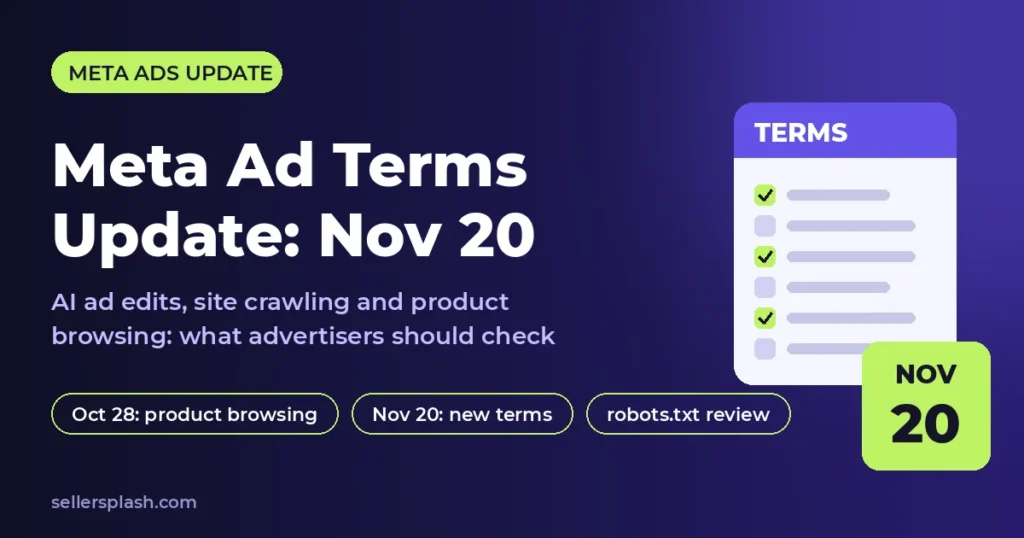
Meta's updated ad terms now take effect on November 20, 2026, three weeks later than the original October 30 date. Meta's Business Help Center confirms the new date and says the update folds the Product Catalog Terms into the Meta Commercial Terms and the Ad Creative Generative AI Terms into the Self-Serve Ad Terms. For advertisers, the practical work before then is to review the AI creative features in your ads, decide which Meta crawlers can read your site, and settle the product browsing default that Meta says switches on for existing ads on October 28.
This guide covers what changed, what the delay does and does not mean, and a checklist you can work through this week. Every claim links to its source. It is a marketing guide, not legal advice.
Quick Answer
On October 23, 2026, a Meta spokesperson told Reuters that Meta is "extending the effective date of our updated Commercial Terms and Self-Serve Ad Terms to 20 November to allow more time for us to explain to our partners and stakeholders what's changing and what's not," as quoted by PPC Land. Meta did not say it would rewrite anything, so plan as if the current preview text is what applies on November 20.
- New date: November 20, 2026 for both the Meta Commercial Terms and the Self-Serve Ad Terms.
- AI ad edits: a new AI Features section makes the advertiser responsible for what Meta's AI tools create or change, according to PPC Land's summary of Adweek's reporting.
- Site crawling: businesses authorize Meta to crawl and create test credentials for sites tied to their products, for advertising and business products, per the preview wording PPC Land quotes.
- Product browsing: a separate advertiser notice says in-app product browsing turns on for existing ads on October 28, 2026 unless you opt out, according to PPC Land.
| Change | Date | What to do |
|---|---|---|
| Product browsing on by default for existing ads | October 28, 2026 | Opt out or test it in Advantage+ creative and destination settings |
| Product Catalog Terms merged into Commercial Terms | November 20, 2026 | Read the Commercial Terms preview if you run catalog or Shopping ads |
| Ad Creative Generative AI Terms merged into Self-Serve Ad Terms | November 20, 2026 | Audit AI creative enhancements on every live ad |
| Crawling and test credentials clause | November 20, 2026 | Review robots.txt rules for Meta's crawlers and any gated pages |
What Changed in Meta's Ad Terms
Two sets of terms become one each
Meta's help article lists two consolidations: the Product Catalog Terms are incorporated into the Meta Commercial Terms, and the Ad Creative Generative AI Terms are incorporated into the Self-Serve Ad Terms. Meta says these changes "reduce overlap between our agreements and improve the clarity of the terms." If you advertise with a product catalog or use Meta's generative creative tools, the rules that used to sit in side documents now live in the main contracts you already accept by running ads.
AI Features: the advertiser carries the risk
Adweek found a new section titled "AI Features" in the revised Commercial Terms. As PPC Land summarizes it, the section says Meta's AI features "may make mistakes and may not always produce accurate, complete, or suitable results," and that businesses are "solely responsible" for what those features create or change. The language reaches features that Meta turns on, not only ones an advertiser picks. Earlier generative AI terms tied that responsibility to tools an advertiser chose to use.
The same report notes that acceptance needs no click. The current Commercial Terms already say that continuing to use Meta products for business after notice of an update means you agree to it.
Crawling and test credentials
The crawling clause drew the most criticism. An earlier preview let Meta use content from business websites to "train" its products; PPC Land reports that The Verge found that sentence removed on October 17, and that the UK preview had caught up by October 23. The current wording, as PPC Land quotes it, authorizes Meta to use "automated software (such as web scrapers, bots, robots, spiders, crawlers and user agents) and create test credentials" to access domains associated with your products or services, "in order to provide, develop, improve, research and maintain advertising and business products."
Publishers say that is still too broad. Nieman Lab reported legal experts' view that the terms would allow scraping of news sites, and PPC Land notes the clause still does not mention robots.txt, even though Meta's spokesperson told Reuters that content owners will still be able to use robots.txt to signal their preferences.
Product browsing switches on October 28
Separately from the terms, Meta sent advertisers a notice that reads: "Starting October 28, 2026, we'll add product browsing to your existing ads," according to PPC Land. When people tap an ad, they "may see an experience on Facebook or Instagram with product info and personalized suggestions" before reaching your site. Meta's notice claims businesses saw 3% more conversions on average with in-app product browsing, based on an experiment run August 6 to August 21, 2026 across about 117,700 advertisers. PPC Land could not find a Meta Help Center page describing the change as of October 15, so treat the notice inside your account as the source of record.
What the Delay Does and Does Not Mean
The delay buys three weeks, not new wording. Meta framed the extra time as a chance to explain the existing text, and PPC Land reports that publisher groups in the EU and UK are still pushing regulators to force changes before November 20. That means two things for advertisers:
- Act on the current preview. If nothing changes, the preview text is what you accept by running ads on November 20.
- Recheck before the date. Read the Commercial Terms preview and the Self-Serve Ad Terms preview again in mid November in case Meta revises them.
What Advertisers Should Do Before November 20
- Decide on product browsing before October 28. Open the notice in your ad account or the Advantage+ creative and destination settings on each ad. If your landing pages carry offers, bundles or upsells that matter to margin, consider keeping some ads off and comparing results rather than flipping every ad at once.
- Audit Advantage+ creative enhancements. List every AI enhancement switched on across live ads, including the kinds of edits PPC Land describes: adding visual elements, translating text or generating new images from your own photos. Since the advertiser carries the risk for AI output, keep on only the enhancements you are willing to review, and preview ads across placements before launch.
- Set a review routine for AI generated variants. Check ad previews weekly during peak season for wrong claims, altered products or off brand visuals. Regulated categories such as supplements, finance and health deserve the closest look.
- Review robots.txt for Meta's crawlers. Meta's web crawler documentation lists separate user agents: Meta-ExternalAds for advertising products, Meta-ExternalAgent for uses such as training foundation AI models, Meta-WebIndexer for Meta AI search results, and FacebookExternalHit for link previews. Decide which to allow on purpose instead of by default.
- Protect gated content. The clause mentions test credentials, so check what sits behind logins on your site: wholesale price lists, member pricing or customer portals. Keep anything sensitive behind proper authentication and out of public sitemaps.
- Loop in whoever signs contracts. If you run large budgets or work in a regulated industry, have your legal contact read the previews before November 20. Agencies should brief clients too, since each business accepts the terms simply by continuing to run ads.
- Put both dates on the calendar. October 28 for product browsing and November 20 for the terms, plus a reminder in mid November to recheck the preview pages.
A Starting robots.txt for Meta's Crawlers
Meta says on its crawler page that to block a crawler you add a disallow for it in robots.txt. One reasonable setup for an online store that wants link previews, ad features and Meta AI citations, but not model training, looks like this:
User-agent: facebookexternalhit
Allow: /

User-agent: meta-externalads
Allow: /

User-agent: meta-webindexer
Allow: /

User-agent: meta-externalagent
Disallow: /
Two cautions. Meta's documentation says Meta-ExternalFetcher, which fetches links at a user's request, "may bypass robots.txt rules," and that FacebookExternalHit might bypass robots.txt for security or integrity checks. And allowing Meta-WebIndexer is what Meta says "helps us cite and link to your content in Meta AI's responses," so blocking it can cost you visibility in AI answers. If AI citations matter to your brand, our guide to answer engine optimization explains how assistants pick sources.
How Seller Splash Helps
Our Meta ads agency team reviews Advantage+ creative settings ad by ad, sets up clean tests for defaults like product browsing, and keeps catalog and tracking in order so changes are measured against real orders. On the AI side, our AI search optimization work covers crawler access and the content that assistants such as Meta AI, ChatGPT and Gemini cite.
Want to know how AI assistants see your store? Get your free AI visibility score in a few minutes, or request the Full AI Visibility Audit for the full picture.
Frequently Asked Questions
When do Meta's new ad terms take effect?
Meta's Business Help Center says the updated Meta Commercial Terms and Self-Serve Ad Terms take effect on November 20, 2026. They had been set for October 30, 2026, until Meta announced a three week delay on October 23.
Do I have to sign or click anything to accept the new terms?
No. Under the terms, continuing to use Meta's products for business after the effective date counts as accepting the update, as both the current Commercial Terms and Adweek's reading of the new version describe. The stated alternative is to stop using Meta's products for business.
Who is responsible if Meta's AI changes my ad and gets it wrong?
According to Adweek's reading of the new AI Features section, the advertiser is solely responsible for what Meta's AI features create or change, including features Meta turns on by default. Review your Advantage+ creative enhancements and preview every ad before it runs.
Can I stop Meta from crawling my store with robots.txt?
Meta's crawler documentation says you can disallow its crawlers in robots.txt, with separate user agents for ads, AI training and Meta AI search. A Meta spokesperson also told Reuters that robots.txt will keep working, but the preview terms themselves do not mention robots.txt, and Meta notes that some fetchers may bypass it.
What is Meta product browsing and should I turn it off?
Product browsing shows product details and personalized suggestions inside Facebook or Instagram after someone taps your ad, before they reach your site. Meta's notice says it switches on for existing ads on October 28, 2026 unless you opt out. Test it on a share of spend rather than accepting or rejecting it blind.
AI search and ads readiness checklist
25 checks for Amazon, Walmart and Shopify sellers: tracking, product feeds, Google, Bing and Meta ads, and getting cited by ChatGPT, Perplexity and Google AI Overviews. Two pages, about 20 minutes.
- Break-even ROAS table by margin
- The AI search (AEO) checks most stores miss
- A simple score that tells you what to fix first
No spam. We use your email to send the checklist and follow up about it.
Want to see where your store stands in AI search? Run the free AI Visibility Score, or get the Full AI Visibility Audit for $99.
Get your AI visibility audit