Responsive Search Ads Best Practices: Ad Strength and Pinning
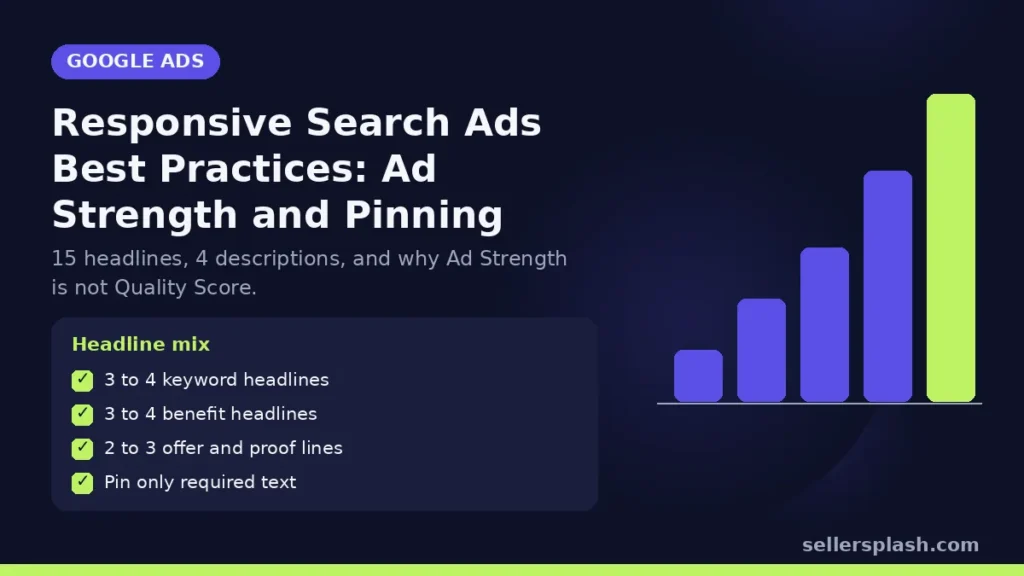
A responsive search ad lets you enter up to 15 headlines and 4 descriptions, and Google Ads assembles them into different combinations for each search. Google's help center recommends at least two responsive search ads with "Good" or "Excellent" Ad Strength in each ad group, each with a unique final URL. The two decisions that matter most for an online store are how varied your headlines are and how much you pin, because pinning limits the combinations Google can test. This guide covers the limits, what Ad Strength actually measures, and a practical way to write strong assets for product and category campaigns.
Responsive Search Ad Limits
| Element | How many | Character limit |
|---|---|---|
| Headlines | Up to 15 | 30 each |
| Descriptions | Up to 4 | 90 each |
| Display path fields | 2 | 15 each |
Source: Google Ads Help, About responsive search ads. Google notes that characters in double width languages such as Korean, Japanese or Chinese count as 2, and that a responsive search ad can show up to 3 headlines in the headline position, with at least one headline and one description in every ad.
What Ad Strength Does and Does Not Do
Ad Strength rates how well your assets work together for the keywords in the ad group, from Poor to Excellent. Google's Ad Strength article is explicit about a common misconception: Ad Strength is a feedback tool for asset diversity and combination testing, and it isn't used to calculate Ad Rank, Quality Score or auction wins. The rating also doesn't directly affect whether your ad is eligible to serve.
So why care? Google reports that advertisers who improve Ad Strength from Poor to Excellent see 15% more clicks and conversions on average, and that adding a second responsive search ad to an ad group with one brings a 6.6% average increase in conversions at a similar cost per conversion. Treat those as Google's averages, not a promise, and use Ad Strength as a checklist for variety rather than a score to chase for its own sake.
Google also notes what Ad Strength cannot see: it does not measure your landing page or how good your offer is. A store with an Excellent ad and a slow, confusing product page still loses the sale.
When to Pin, and When Not To
Pinning fixes a headline or description to a position. Google's guidance says that if you have text that must appear in every ad, you must pin it to Headline position 1, Headline position 2 or Description position 1. Pinning one asset to a position means only that asset can show there, which cuts the number of combinations Google can try and usually lowers Ad Strength.
Good reasons to pin for a store:
- A legally required disclaimer or pricing term
- A brand name your trademark agreements require in a set position
- A product name that must lead in a single product ad group
If you need a message in position 1 but want some variety, pin two or three alternative headlines to that same position. Google can then rotate between them.
How to Write 15 Headlines for an Online Store
Variety is what Ad Strength rewards, and it is also what gives Google more useful combinations. A simple split for a product or category ad group:
- 3 to 4 keyword headlines: the product or category name in the words shoppers search, for example "Waterproof Trail Running Shoes."
- 3 to 4 benefit headlines: what the product does for the buyer, such as grip, fit or durability.
- 2 to 3 offer headlines: free shipping thresholds, return windows or warranty terms you actually offer.
- 2 to 3 proof headlines: verifiable facts, such as years in business or materials used.
- 1 to 2 call to action headlines: "Shop the Collection," "Find Your Size."
Write each headline so it makes sense on its own. Google's help center reminds advertisers that assets can be shown in any order, so they need to read correctly individually or in combination. For descriptions, use one to expand the main benefit, one for the offer and returns, one for product details, and one with a clear call to action.
Setup Checklist: 6 Steps
- Keep ad groups tight, so headlines can match the keywords closely.
- Write at least 10 distinct headlines and 4 descriptions per ad, aiming for 15 headlines.
- Pin only what must appear, and pin alternatives together to the same slot.
- Run 2 responsive search ads per ad group, each with a unique final URL where it makes sense.
- Review asset performance in the report after the ad has enough impressions, and replace the weakest assets.
- Check the landing page matches the promise in the headline: price, shipping and stock.
Quick Checklist
- Headlines under 30 characters, descriptions under 90
- Keyword, benefit, offer, proof and call to action headlines
- Pins only for required text
- Two ads per ad group with Good or Excellent Ad Strength
- Every claim in the ad true on the landing page
Where an Agency Fits
Ad copy is one lever among many in a search account. Our Google Ads management covers structure, feeds, bidding and copy together, and our guide to negative keywords covers the other side of search relevance.
Want an outside review of your paid search? The Full AI Visibility Audit ($99) reviews how search and AI assistants see your brand, and the Deep Growth Audit ($249) adds search, traffic, ads and product feed checks with a 90 day plan.
Frequently Asked Questions
How many headlines can a responsive search ad have?
Up to 15 headlines of up to 30 characters each, plus up to 4 descriptions of up to 90 characters each and two path fields of up to 15 characters.
Does Ad Strength affect Quality Score or Ad Rank?
No. Google says Ad Strength is a feedback tool for asset diversity and is not used to calculate Ad Rank, Quality Score or auction wins, and it doesn't directly affect whether an ad can serve.
Should I pin headlines in responsive search ads?
Only text that must appear in every ad, such as required disclaimers. Pinning reduces the combinations Google can test. If you pin, consider pinning two or three alternatives to the same position.
How many responsive search ads should each ad group have?
Google recommends at least two responsive search ads with Good or Excellent Ad Strength per ad group, each with a unique final URL.
Why is my Ad Strength Poor?
Usually too few headlines, headlines that repeat the same idea, too much pinning or headlines that do not reflect the ad group's keywords. Ad Strength is mainly about variety and keyword relevance.
Does a better Ad Strength guarantee more sales?
No. Google reports average gains for advertisers who improve Ad Strength, but Ad Strength does not measure your landing page or offer, which also decide conversions.
AI search and ads readiness checklist
25 checks for Amazon, Walmart and Shopify sellers: tracking, product feeds, Google, Bing and Meta ads, and getting cited by ChatGPT, Perplexity and Google AI Overviews. Two pages, about 20 minutes.
- Break-even ROAS table by margin
- The AI search (AEO) checks most stores miss
- A simple score that tells you what to fix first
No spam. We use your email to send the checklist and follow up about it.
Want to see where your store stands in AI search? Get the Full AI Visibility Audit for $99 or the Deep Growth Audit for $249.
Get your AI visibility audit